Optimize Every Stage with Real-Time Subsurface Intelligence
MicroSeismic helps completions teams understand fracture behavior, detect structural risks, and improve decisions while operations are still underway.
- Stress Shadow Effects
- Poro-Elastic Pressure Hits
- Fluid and Proppant Invasion
- Production and Pressure Communication
- Casing Deformation
- Fault Reactivation
- Asymmetrical Fracture Growth
- Parent-child Well Interactions
- Geomechanics
- Fracture Geometry
- Treatment Parameters
- Well and Stage Spacing
- SRV – Propped and Unpropped
- Pump Schedule
- Refracs
- Induced Seismicity
- Hydraulic Stimulation
- Geohazard Avoidance
- Bedding Plane Slip
- Wellbore Shear
- Treatment Order
- Infill Strategies
- Tank Development
- New Acreage and Step-outs
- Depletion
- Well Spacing
ROI Impact Case Studies
How To Out-Perform Your Competition
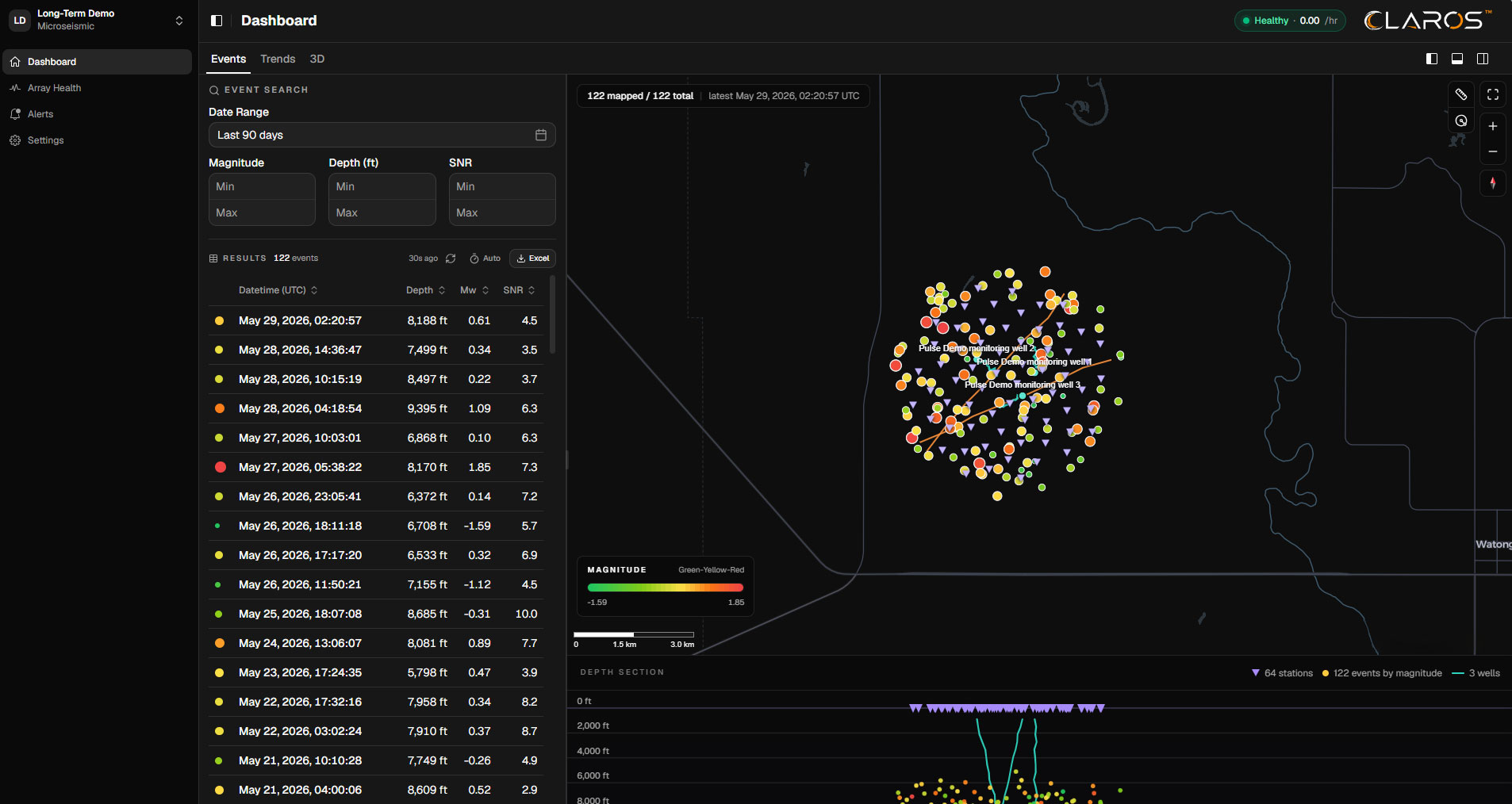
Meet Claros – Your Seismic Data, at Your Fingertips
The microseismic monitoring behind FracRX captures a detailed picture of how your completions actually perform.
Claros turns that picture into answers.
Our new SaaS software brings your FracRX results into a single, intuitive interface, so your team can access, interpret, and act on monitoring data faster, without writing on a report or wrangling raw files.
Book a Demo
Unlocking ROI
Using Surface Array Data to Optimize Fracture Performance and Completion Design
Taming Frac-Driven Interactions
Stress changes due to treatment order influences fluid and proppant flow
- Compounding Pore-Pressures
- Stresses rotate
- Focal Mechanisms change (e.g. Normal Dip-Slip to Strike-Slip in Normal Stress Regime)
- Isolated wells
- Fluid and proppant located in targeted zone
- Rapid stage lag
- Contains treatment on either side of well
- Long stage lag
- Loss of fluid and proppant to previously treated well
New Acreage
Treatment can be adjusted in real-time
- Determine treatment design and associated spacing sensitivities (e.g. stage and wellbore spacing)
- Run iterative field diagnostics
- Numerically calibrate model
- Test modeled results in real time, update model and make changes as needed
- Understand if treatment is staying in zone
- Assess effectiveness of treatment (e.g. diverter)
- Adjust injected volume and proppant mass accordingly
- Determine if frac-hits are occurring on offset wells
Refracturing Without a New Liner
A low-rate, long-duration pressurization step maintains pressure below the fracture closure pressure and encourages re-pressurization of the entire lateral.
- Assess effectiveness of diverter at wellbore scale
- Determine if rock is breaking during initial pressurization step
- Determine if treatment is effectively stimulating entire wellbore
Infill Drilling
Pressurizing parent well reduces fluid propagation of child well towards depleted parent well.
- EUR uplift +25%
- ROI after 1-2 months of production
- Child-parent and child-child interactions are observed during microseismic monitoring
- Moving beyond the dots-in-the-box to fracture permeability models permits a rapid evaluation of the impact child wells have on child/parent wells
Geohazards
Faulting can be identified in real time by focal mechanisms allowing for rapid adjustments to treatment design
- Faults are detectable in real time
- This permits rapid adjustment to treatment design such as:
- Lowering rate
- Increasing viscosity
- Injecting diverter
- Defining no perf zones
Establish a Baseline for Naturally Occurring Seismicity Prior to Injection
Pressurizing parent wells fluid propagation of child well towards depleted parent well.
- Subsurface monitoring over the life of the asset helps to demonstrate proactive stewardship of field operations
- Event resolution from our service can be 10x better than measurements available from public networks such as USGS and NRCan; helping to accurately pinpoint and demonstrate the safety of subsurface treatment activities
- Our service also includes real-time event alerts sent directly to your smartphone, as well as weekly reporting of activities
We create VALUE for customers by reducing development costs, mitigating geohazards, and increasing reservoir performance.
Every Well Is Unique, So Let’s Work Together!
Please send us some information about your project so we can increase your production and cut your costs.