
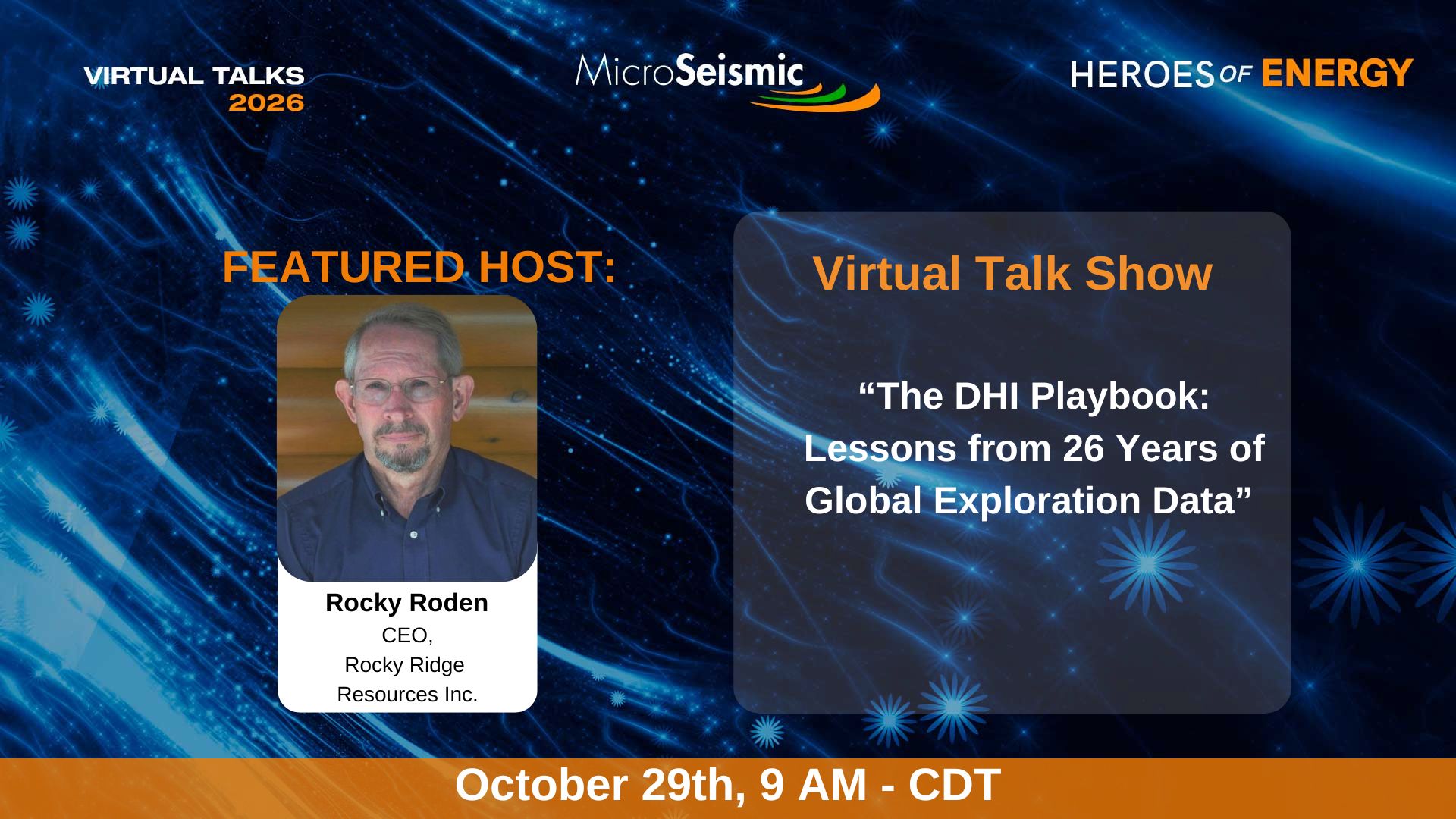
The DHI Playbook: Lessons from 26 Years of Global Exploration Data
Advancements in seismic acquisition technology are delivering higher-resolution data while minimizing environmental footprint.


Do you have new perspectives, standout case studies, or groundbreaking research that could spark meaningful conversations in the energy industry?
Submit your abstract for consideration

This presentation highlights new insights gained through Distributed Fiber Optic Sensing (DFOS). Acting as a “subsurface nervous system,” fiber-optic cables installed in offset monitoring wells simultaneously record high-frequency microseismic signals and high-resolution strain changes. These measurements enable imaging of pre-existing fractures and direct observation of their reactivation during hydraulic stimulation.
Using field examples from unconventional oil and gas reservoirs and Enhanced Geothermal Systems (EGS), we demonstrate how local geology can significantly influence fracture growth and behavior. Key observations include:
These high-resolution DFOS measurements provide unprecedented insight into the relationship between geology and fracture mechanics. The results offer valuable opportunities to:
By revealing how hydraulic fractures interact with existing subsurface structures, DFOS is transforming our ability to characterize reservoirs and improve stimulation design.
Dr. Ge Jin is Associate Professor of Geophysics and co-PI of Reservoir Characterization Project at Colorado School of Mines. His research focuses on Distributed Fiber-Optic Sensing (DFOS) applications in the fields of oil & gas, geothermal, CO2 sequestration, smart city, and earthquake hazard. He is also interested in machine-learning applications and seismic imaging. He obtained his Ph.D. in Geophysics from Columbia University in the City of New York, and dual B.S. in Geophysics and Computer Science from Peking University in Beijing. He worked as a research geophysicist in the oil industry for five years before joining Colorado School of Mines as a faculty member in 2019.d

Advancements in seismic acquisition technology are delivering higher-resolution data while minimizing environmental footprint.
Copyright 2026 MicroSeismic Inc.